Queen Hatshepsut was one of the most remarkable rulers in the history of ancient Egypt. At a time when kingship was traditionally associated with men, she became pharaoh and ruled Egypt during one of the most prosperous periods of the New Kingdom. Her reign was not defined by conquest alone. Instead, Hatshepsut strengthened the economy, encouraged international trade, commissioned impressive monuments, and presented herself through art and architecture as a legitimate ruler chosen by the gods.
Today, her name is closely connected with Luxor, one of Egypt’s greatest historical destinations. Her magnificent mortuary temple at Deir el-Bahari remains one of the most recognizable monuments on the West Bank of the Nile. A visit to this temple offers travelers the opportunity to see how architecture, religion, politics, and royal identity came together in ancient Egypt.
This guide explores Hatshepsut’s rise to power, her achievements as pharaoh, the famous expedition to Punt, her building projects, her unusual artistic representations, and the history of her temple. It also explains why her reign remains important and how modern travelers can experience her legacy during a visit to Luxor.
Who Was Hatshepsut?
Hatshepsut was born into Egypt’s royal family during the early 15th century BCE. She was the daughter of Pharaoh Thutmose I and Queen Ahmose. Her royal ancestry gave her a strong connection to the ruling dynasty, which later became an important part of her claim to the throne.
Her name is usually translated as “Foremost of Noble Women.” She belonged to the 18th Dynasty, a dynasty that played a central role in the beginning of Egypt’s New Kingdom.
Hatshepsut became the Great Royal Wife of her half-brother, Thutmose II. This marriage followed an important tradition in Egyptian royal families, where royal marriages could help preserve the legitimacy of the ruling line.
Thutmose II eventually died while Hatshepsut was still a relatively young woman. His successor was Thutmose III, the son of Thutmose II and a secondary wife named Isis.
Because Thutmose III was still a child, Hatshepsut initially served as regent.
At first, her role was officially connected to protecting and governing Egypt on behalf of the young king. However, within several years, Hatshepsut adopted the full titles and symbols of pharaonic authority.
This transformation made her one of the very few women in ancient Egyptian history to rule as pharaoh.
How Did Hatshepsut Become Pharaoh?
Hatshepsut’s rise to power was unusual, but it did not happen suddenly.
After the death of Thutmose II, Hatshepsut became regent for Thutmose III. During this period, she already possessed considerable political influence because of her royal birth and her position as the former king’s Great Royal Wife.
Eventually, she was proclaimed king.
Ancient Egyptian inscriptions and monuments present her rule as legitimate and divinely supported. One famous tradition describes the god Amun as having selected Hatshepsut for kingship. Her monuments emphasized that her father, Thutmose I, had recognized her as his successor.
These claims were important because Egyptian kingship was deeply connected to religion.
The pharaoh was not simply a political leader. The ruler was responsible for maintaining maat, the principle of cosmic order, justice, balance, and harmony.
For Hatshepsut to rule successfully, she therefore needed more than political authority. She needed to demonstrate that her position was compatible with Egyptian religious traditions.
Her monuments repeatedly communicated this message.
Hatshepsut’s Relationship with Thutmose III
Hatshepsut’s relationship with Thutmose III is one of the most debated subjects in Egyptian history.
For many years, popular accounts suggested that Hatshepsut deliberately prevented Thutmose III from ruling and that he later destroyed her monuments in revenge.
Modern scholarship presents a more complicated picture.
During Hatshepsut’s reign, Thutmose III remained an important member of the royal family and eventually became one of Egypt’s greatest military rulers. There is evidence that he held important responsibilities during her lifetime.
Hatshepsut also did not completely remove Thutmose III from the monuments of the period. In some scenes, both rulers appear together.
This suggests that the political situation was more complex than a simple struggle between two enemies.
It is possible that Hatshepsut’s rule was initially necessary because Thutmose III was too young to govern independently. Once she had established her authority, the two rulers could operate within a shared political system, although Hatshepsut clearly held the dominant position for much of her reign.
After Hatshepsut’s death, Thutmose III ruled Egypt for many years. He became famous for his military campaigns and expansion of Egyptian influence.
Why Did Hatshepsut Dress as a Pharaoh?
One of the most famous aspects of Hatshepsut’s representation is her appearance in traditional male royal imagery.
Statues of Hatshepsut sometimes show her wearing the royal nemes headdress, false beard, and traditional pharaonic clothing. Other representations show her with more feminine physical characteristics.
This does not necessarily mean that Hatshepsut was attempting to hide her identity as a woman.
Ancient Egyptian royal art followed a highly symbolic visual language. The image of the pharaoh was not intended to provide a realistic portrait in the modern sense. It communicated the ruler’s role and authority.
The false beard, for example, was an established symbol of kingship.
Hatshepsut’s artists therefore used traditional royal imagery to communicate a clear political message: she was not merely a queen acting temporarily on behalf of a king. She was the pharaoh.
At the same time, some inscriptions and artistic details continued to identify her as a woman.
Her representations demonstrate how flexible Egyptian royal imagery could be when political circumstances required it.
Hatshepsut and the Power of Trade
One of Hatshepsut’s greatest achievements was her emphasis on trade and economic development.
Rather than defining her reign primarily through military expansion, Hatshepsut invested heavily in commercial expeditions and international exchange.
The most famous example is the expedition to the land of Punt.
Punt was a region whose exact location remains uncertain. Many researchers place it somewhere in the Horn of Africa or along the southern Red Sea region. Ancient Egyptian sources associated Punt with valuable goods that were difficult to obtain in Egypt.
These included:
- Frankincense
- Myrrh
- Ebony
- Gold
- Aromatic plants
- Exotic animals
- Other luxury products
Hatshepsut organized a major expedition to Punt during her reign.
The journey was recorded in detailed reliefs at her mortuary temple at Deir el-Bahari. These scenes are among the most valuable visual records of ancient Egyptian trade.
The Famous Expedition to Punt
The reliefs at Deir el-Bahari show ships traveling across the sea, arriving in Punt, and returning to Egypt with valuable goods.
The expedition appears to have been highly organized.
Egyptian ships were loaded with trade goods and sailed southward toward the region of Punt. Once there, the Egyptian representatives exchanged goods and obtained products desired by the Egyptian court.
One of the most interesting aspects of the reliefs is the attention given to the natural environment.
The scenes show trees, animals, houses, boats, and people.
Among the most famous images are frankincense trees being transported to Egypt.
Hatshepsut’s inscriptions describe the expedition as a major success. They emphasize that the gods, especially Amun, supported the journey.
The expedition was important for both economic and political reasons.
It demonstrated Egypt’s ability to conduct long-distance trade and reinforced Hatshepsut’s image as a ruler who brought prosperity to the country.
Instead of showing the pharaoh only as a warrior, the monuments presented her as a provider who enriched Egypt.
Why Was Punt Important?
The products obtained from Punt were valuable because they played important roles in Egyptian religious life.
Frankincense and myrrh could be used in religious rituals, temple ceremonies, and royal contexts. Their fragrances were associated with sacred spaces and offerings.
The expedition also demonstrated Egypt’s connections with regions beyond the Nile Valley.
Ancient Egypt was not an isolated civilization. It maintained relationships with neighboring kingdoms and distant trading partners throughout its history.
The Punt expedition is therefore important because it gives historians evidence of maritime travel, international commerce, political organization, and cultural contact.
For modern visitors, the reliefs at Deir el-Bahari provide a rare visual window into this ancient world.
Hatshepsut’s Building Program
Hatshepsut was one of the great builders of ancient Egypt.
Her reign produced temples, obelisks, statues, sanctuaries, and architectural additions at important religious centers.
Her building program served several purposes.
First, it honored the gods.
Second, it strengthened the religious institutions that supported Egyptian society.
Third, it communicated her legitimacy as pharaoh.
Finally, monumental construction provided a permanent statement of royal power.
Hatshepsut’s monuments can be found in several important locations, but Luxor and the ancient city of Thebes are particularly associated with her reign.
Hatshepsut at Karnak Temple
Karnak was one of the most important religious complexes in ancient Egypt.
Located on the east bank of the Nile in modern Luxor, Karnak developed over many centuries and was particularly associated with the god Amun.
Hatshepsut contributed significantly to the complex.
She commissioned large obelisks and other monuments dedicated to Amun. Her famous obelisks were carved from single blocks of granite and transported from the quarries of Aswan.
The surviving obelisk of Hatshepsut at Karnak is an impressive reminder of the engineering abilities of ancient Egyptian workers.
The original monument was enormous.
Its polished surface would have reflected sunlight, making the obelisk highly visible within the temple complex.
Hatshepsut’s inscriptions on the obelisks also reinforced her relationship with Amun and her legitimacy as ruler.
The Temple of Deir el-Bahari
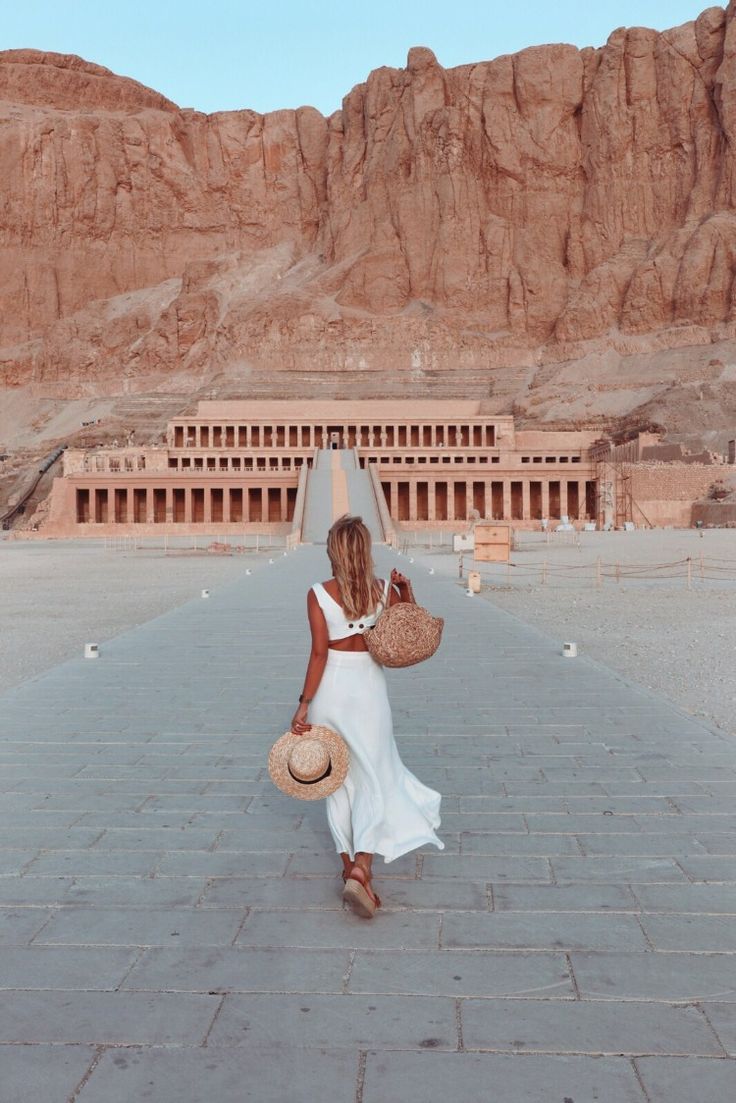
The monument most closely associated with Hatshepsut is her mortuary temple at Deir el-Bahari.
The temple stands on the West Bank of the Nile near Luxor, beneath dramatic limestone cliffs.
Its formal name connected the monument with Hatshepsut and the god Amun. The temple was designed as a place for religious rituals, royal commemoration, and the worship of the gods.
Its architecture is striking even today.
The temple consists of broad terraces connected by ramps. Long horizontal lines contrast with the steep cliffs behind the monument.
The result is one of the most visually impressive architectural compositions in ancient Egypt.
What Makes Deir el-Bahari Special?
The Temple of Hatshepsut is different from many other Egyptian temples.
Its design makes extensive use of terraces and colonnades. Instead of appearing as a massive enclosed structure, the temple gradually rises toward the cliffs.
The architecture creates a powerful relationship between the natural landscape and the human-built monument.
This was not accidental.
Ancient Egyptian architects frequently considered the surrounding environment when planning sacred structures. At Deir el-Bahari, the cliffs become part of the visual experience.
The temple seems to emerge from the mountain.
This connection between architecture, landscape, and religion is one of the reasons Deir el-Bahari remains so popular with visitors.
The Reliefs of Hatshepsut’s Temple
The walls of the temple were decorated with scenes illustrating important religious and political events.
Some scenes show the divine birth of Hatshepsut.
Others depict her connection with the god Amun.
The famous expedition to Punt is also represented in detail.
These reliefs are valuable historical sources because they provide information about ancient Egyptian ships, trade, clothing, architecture, plants, and animals.
The Punt scenes are particularly famous because they show a foreign environment and people in considerable detail.
For historians, such scenes are more than decoration. They provide evidence that can be compared with archaeological and textual discoveries.
Hatshepsut’s Divine Birth
One of the most important scenes at Deir el-Bahari presents Hatshepsut’s divine birth.
The story explains that the god Amun took the form of her father, Thutmose I, and visited her mother.
Hatshepsut’s birth was therefore presented as divinely ordained.
This story served an important political purpose.
If Hatshepsut was chosen by Amun and born through divine intervention, her claim to kingship could be presented as part of a sacred plan.
This type of religious messaging was not unusual in ancient Egyptian kingship.
Pharaohs often emphasized their relationships with the gods, especially when political circumstances required additional justification.
For Hatshepsut, divine birth imagery helped establish that her rule was not an accident.
Hatshepsut as a Peaceful Ruler
Hatshepsut is sometimes described as a peaceful pharaoh because her reign is remembered more for construction and trade than for major military conquests.
However, it would be inaccurate to assume that Egypt completely abandoned military activity during her reign.
Egypt remained a powerful kingdom, and military campaigns continued.
Nevertheless, Hatshepsut’s surviving monuments emphasize prosperity, religion, trade, and construction more strongly than military conquest.
This gives her reign a distinctive character.
Her approach demonstrated that Egyptian power could be expressed through economic prosperity and monumental architecture as well as warfare.
Hatshepsut and Egyptian Art
Hatshepsut’s reign was also significant for artistic development.
Artists working for her produced sculptures and reliefs that combined traditional royal imagery with new approaches to representing a female ruler.
Some statues show Hatshepsut with a feminine body and royal headdress.
Others depict her with the muscular proportions traditionally associated with male pharaohs.
Still others combine both approaches.
This variety reflects the challenge faced by royal artists.
They had to communicate two ideas at once: Hatshepsut was a woman, but she was also the king.
Rather than choosing only one identity, Egyptian art created a visual language that could accommodate both.
What Happened to Hatshepsut After Her Death?
Hatshepsut died after ruling Egypt for many years.
Her successor, Thutmose III, eventually became sole ruler and began an extensive building program of his own.
At some point after Hatshepsut’s death, many of her images and inscriptions were damaged or removed.
For a long time, historians interpreted this as deliberate erasure carried out by Thutmose III because of personal hatred or political revenge.
Today, scholars generally approach the subject more cautiously.
The destruction appears to have occurred in stages and may have been connected with questions of royal succession and the presentation of legitimate kingship.
Hatshepsut’s name and images were removed from some monuments, but many of her buildings survived.
Her temple at Deir el-Bahari, for example, remained an important landmark even after her memory was attacked.
The Rediscovery of Hatshepsut
For centuries, Hatshepsut was not as famous as many other Egyptian pharaohs.
Much of her story had been obscured by the removal of her name and images from monuments.
Modern archaeology gradually reconstructed her history.
Researchers studying inscriptions and monuments began to recognize that the female ruler represented in several surviving monuments was Hatshepsut.
Her story became increasingly clear as archaeologists examined inscriptions, statues, temple reliefs, and royal genealogies.
Today, she is recognized as one of the most important rulers of the 18th Dynasty.
Her rediscovery is itself an important part of Egyptology because it demonstrates how historical memory can be changed by political decisions.
Hatshepsut’s Tomb and Burial
Hatshepsut’s tomb is located in the Valley of the Kings on Luxor’s West Bank.
Her tomb is known as KV20.
The tomb is unusual because it was originally connected with the reign of Thutmose I and was later adapted for Hatshepsut.
It extends deep into the mountain and reflects the changing traditions of royal burial during the New Kingdom.
Hatshepsut’s burial history is complex.
Her mummy was not immediately identified with certainty, and the subject has been investigated by archaeologists for many years.
A mummy found in a cache at Deir el-Bahari was eventually identified by researchers as Hatshepsut, although the process involved scientific analysis, historical evidence, and comparison with members of the royal family.
The discovery added another dimension to the story of the famous female pharaoh.
Why Is Hatshepsut Important in Ancient Egyptian History?
Hatshepsut’s importance goes far beyond the fact that she was a woman who became pharaoh.
Her reign demonstrates how Egyptian political institutions could adapt to unusual circumstances.
She successfully ruled a powerful kingdom and maintained the traditional religious and political structures of pharaonic Egypt.
Her economic policies encouraged international trade.
Her building projects transformed important religious sites.
Her monuments provide some of the best surviving evidence for Egyptian contact with Punt.
Her temple demonstrates the extraordinary level of Egyptian architectural planning.
Her reign also challenges modern assumptions about gender and political authority in the ancient world.
Hatshepsut did not simply occupy a position normally reserved for a man. She adopted the symbols of kingship and used traditional religious ideology to establish her authority.
Her success demonstrates that ancient Egyptian concepts of kingship could be more flexible than they may initially appear.
Visiting Hatshepsut’s Temple in Luxor Today
For modern travelers, one of the best ways to understand Hatshepsut’s legacy is to visit Luxor.
Luxor contains an extraordinary concentration of ancient Egyptian monuments. The modern city stands near the site of ancient Thebes, which was one of the most important political and religious centers of ancient Egypt.
A visit to the West Bank can combine several major attractions.
Travelers can explore:
- The Temple of Hatshepsut
- The Valley of the Kings
- The Colossi of Memnon
- Other archaeological sites on the West Bank
- Ancient tombs and temples
The Temple of Hatshepsut is usually the highlight for visitors interested in the female pharaoh.
Walking toward the terraces, travelers can appreciate the enormous scale of the monument and its dramatic position beneath the cliffs.
The experience becomes even more meaningful after learning about the political and religious ideas represented by the temple.
Best Way to Experience Luxor’s West Bank
A Luxor excursion is easier when the day’s sightseeing is organized around the location of the monuments.
The West Bank is best explored in the morning, particularly during warmer months. Starting early allows visitors to spend more time at the archaeological sites while avoiding the strongest midday heat.
Comfortable shoes are important because visitors may walk considerable distances across archaeological areas.
Sun protection is also essential.
A hat, sunglasses, sunscreen, and sufficient drinking water can make the experience much more comfortable.
For travelers staying in Hurghada, a guided Luxor excursion can be a convenient way to experience the ancient capital without arranging every part of the journey independently.
Best Tours Hurghada offers travelers an opportunity to include Luxor among their Egypt travel experiences, making it possible to discover famous monuments such as the Temple of Hatshepsut while learning more about the history behind them.
A knowledgeable guide can make a major difference because many of the most interesting details are not immediately visible. Understanding the scenes at Deir el-Bahari, the role of Amun, the expedition to Punt, and Hatshepsut’s political position transforms the visit from simple sightseeing into a historical experience.
When planning a trip with Best Tours Hurghada, travelers interested in ancient Egypt can combine their Red Sea holiday with a journey to Luxor and explore a completely different side of the country.
Hatshepsut and the Modern Luxor Experience
One of the most fascinating things about Luxor is the contrast between ancient monuments and modern Egyptian life.
The Nile still flows between the East and West Banks.
The landscape of the West Bank remains dominated by mountains and desert.
The ancient temples still stand against the same dramatic horizon that surrounded them thousands of years ago.
Of course, modern Luxor is very different from ancient Thebes. Yet the geography helps visitors understand why the location was so important.
The Nile provided water and transportation.
The fertile valley supported agriculture.
The desert and mountains provided natural boundaries.
The West Bank became associated with the world of the dead, while major temples and settlements developed on the East Bank.
Hatshepsut’s temple occupies this symbolic landscape perfectly.
Hatshepsut’s Legacy for Travelers
A visit to Hatshepsut’s temple is not simply an opportunity to see an ancient building.
It is an opportunity to explore the story of a ruler who challenged conventional expectations while remaining deeply connected to Egyptian traditions.
Her monuments reveal how ancient Egyptians understood kingship.
Her reliefs reveal the importance of international trade.
Her temple demonstrates the relationship between architecture and landscape.
Her artistic representations show how royal identity could be communicated visually.
Her story also reminds visitors that history is not always preserved exactly as it happened.
Hatshepsut’s memory was partially erased, yet her monuments survived.
Centuries later, archaeology helped restore her place in history.
Frequently Asked Questions About Hatshepsut
Was Hatshepsut the first female pharaoh of Egypt?
No. Hatshepsut was not the first woman to hold royal power in ancient Egypt. However, she was one of the most successful and prominent women to rule Egypt as pharaoh.
How long did Hatshepsut rule Egypt?
Hatshepsut’s period of effective rule lasted roughly two decades during the 18th Dynasty, although the exact chronology and interpretation of her co-rule with Thutmose III are subjects of scholarly discussion.
Why did Hatshepsut wear a false beard?
The false beard was a traditional symbol of pharaonic kingship. Hatshepsut used established royal imagery to present herself as the legitimate king of Egypt.
What was the expedition to Punt?
The expedition to Punt was a major trading mission organized during Hatshepsut’s reign. Egyptian records describe the acquisition of valuable products such as incense, aromatic plants, ebony, gold, and exotic animals.
Where is Hatshepsut’s temple?
Hatshepsut’s mortuary temple is located at Deir el-Bahari on the West Bank of the Nile in Luxor, Egypt.
Can you visit Hatshepsut’s temple today?
Yes. The Temple of Hatshepsut is one of the major archaeological attractions in Luxor and is regularly visited by travelers exploring ancient Egyptian sites.
What else can you see near Hatshepsut’s temple?
The Valley of the Kings and the Colossi of Memnon are among the best-known attractions on Luxor’s West Bank. A well-organized Luxor itinerary can combine several of these sites in one day.
Why is Hatshepsut important today?
Hatshepsut is important because she demonstrated exceptional political leadership, strengthened Egypt’s economy through trade, commissioned major architectural projects, and successfully ruled as a female pharaoh within a traditionally male institution.
Travel Tips for Visiting Hatshepsut’s Temple
Before visiting the Temple of Hatshepsut, consider these practical tips:
Start Early
Morning visits are generally more comfortable, especially during Egypt’s warmer months.
Wear Comfortable Shoes
The archaeological area includes ramps, open courtyards, and walking paths. Comfortable footwear will make the visit easier.
Bring Sun Protection
Luxor can be extremely sunny. Carry sunscreen, sunglasses, and a hat.
Drink Plenty of Water
Stay hydrated throughout the excursion.
Take Time to Study the Reliefs
Do not rush through the temple. The reliefs contain some of the most important historical information about Hatshepsut’s reign.
Visit Other West Bank Sites
Combining Hatshepsut’s temple with the Valley of the Kings and the Colossi of Memnon creates a more complete understanding of ancient Thebes.
Consider a Guided Excursion
A knowledgeable guide can explain the symbolism, historical events, and architectural details that might otherwise be missed.
Hatshepsut: A Pharaoh Who Changed Egyptian History
Hatshepsut’s story is one of ambition, political intelligence, religious symbolism, economic development, and architectural achievement.
She entered a world where kingship was overwhelmingly associated with men, yet she successfully assumed the full authority of pharaoh.
She used traditional Egyptian religious ideas to legitimize her rule.
She supported long-distance trade and celebrated the famous expedition to Punt.
She commissioned enormous building projects that transformed the religious landscape of Egypt.
And she created a remarkable mortuary temple at Deir el-Bahari that remains one of the masterpieces of ancient Egyptian architecture.
Her story did not end with her death.
Although later rulers attempted to reduce her presence in the historical record, her monuments survived. Modern archaeology eventually restored her identity and revealed the scale of her achievements.
Today, Hatshepsut stands among the most fascinating rulers of ancient Egypt.
For travelers visiting Luxor, her story becomes more than a chapter in a history book. It can be experienced directly through the temples, reliefs, statues, and landscapes that remain along the Nile.
Standing beneath the cliffs of Deir el-Bahari, visitors can still see the monument that Hatshepsut built to communicate her power, her faith, and her place in Egyptian history.
For anyone traveling from Hurghada, adding Luxor to an Egypt itinerary offers a remarkable contrast: from the coral reefs and beaches of the Red Sea to the temples and tombs of the ancient Nile Valley. With Best Tours Hurghada, travelers can make that journey part of their Egyptian adventure and discover why Hatshepsut’s legacy continues to attract visitors from around the world.
Conclusion
Queen Hatshepsut was much more than a woman who became pharaoh.
She was a powerful political leader, an ambitious builder, a supporter of international trade, and a master of royal representation. Her reign demonstrated that Egypt could prosper through diplomacy, commerce, religion, and monumental construction.
Her Temple of Deir el-Bahari remains the most powerful physical expression of that legacy.
Its terraces rise dramatically beneath the cliffs of Luxor, while its reliefs preserve stories of divine kingship, trade with Punt, and the world of Hatshepsut’s Egypt.
More than three thousand years after her reign, her achievements continue to shape the way historians understand ancient Egypt.
A visit to Luxor provides the perfect opportunity to encounter this history in person. By walking through Hatshepsut’s temple and seeing the landscapes surrounding ancient Thebes, travelers can connect the surviving monuments with the remarkable woman who ordered them to be built.
Hatshepsut’s story ultimately shows why ancient Egypt continues to fascinate the modern world: its monuments are not only spectacular buildings, but surviving pieces of human stories about power, ambition, faith, identity, and the desire to be remembered.